AI Cataloging — Theirs vs. Ours
Analysis, 2026-06-17. How the purpose-built AI cataloging tools work, where TroveSnap differentiates, the cost-shape difference, the interactivity edge, and the integration stance.
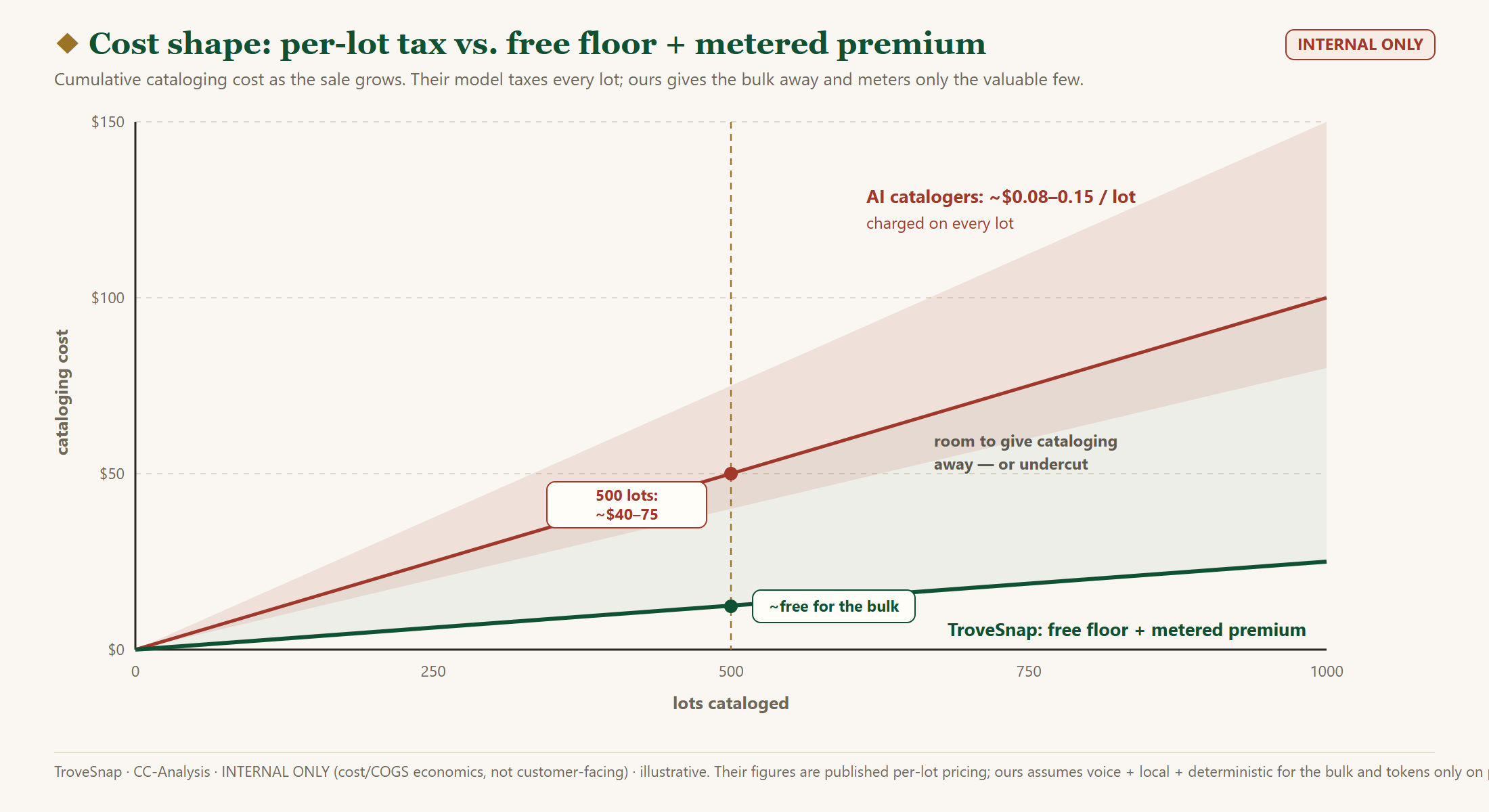
Cost-shape chart: ai-cataloging-cost-shape.svg (PNG) — internal only: cost/COGS economics, never customer-facing (the customer view is on the EstateSale Edition page). Builds on qr-closed-loop-and-sticker-packs and post-sale-inventory-disposition.
The category (table stakes)
A wave of tools — Gavelist, EstateSail, AuctionWriter, Estimint, aListEngine, Circuit Auction AI — do photo → title, description, price, tags (multi-photo: front, backstamp, labels, damage), then export to HiBid / LiveAuctioneers / EstateSales.NET / CSV. Priced per lot (~$0.08–0.15/lot; ~500 lots in ~10 min). The Gavelist guide says running a sale without one is getting hard to justify — i.e., AI cataloging is commoditizing into table stakes. Note: EstateSales.NET itself has no native AI cataloging — it's the directory these tools export into.
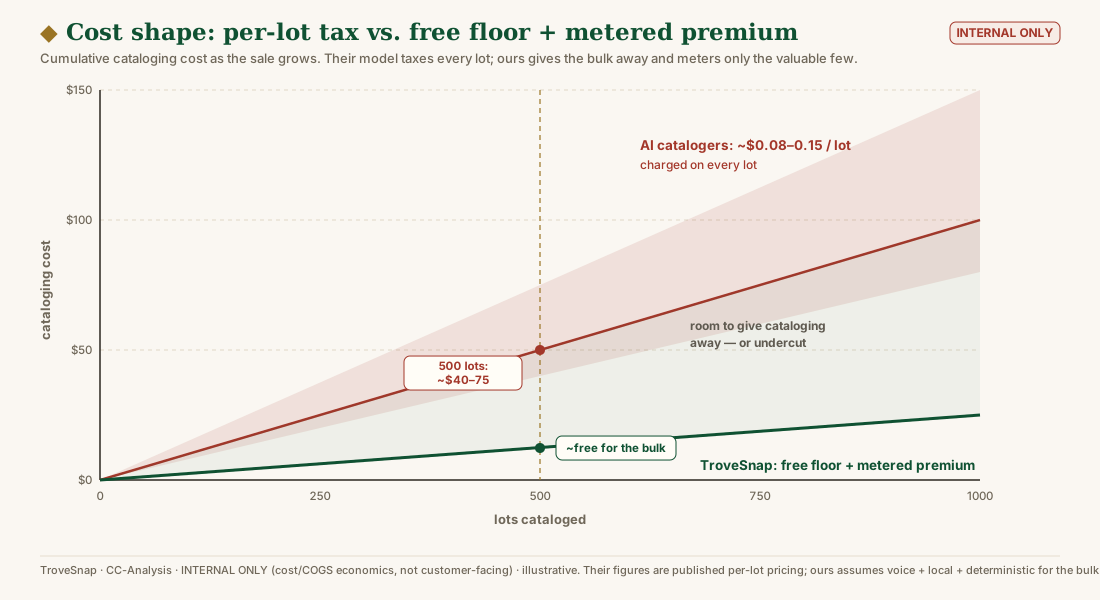
Internal only. This chart shows our cost/COGS economics for planning — it is never shown to customers. The customer-facing view (their cost vs. your advantage) lives on the EstateSale Edition page.
1. Integration stance
Lightweight interop: yes. Deep per-vendor APIs: no.
- These are end-user apps, not callable tagging APIs; their surface is outbound export (CSV / platforms). "Integrate" = ingest their CSV export via the existing ingestion contract. One generic CSV mapper covers all of them.
- Position it as "already cataloging with Gavelist/EstateSail? Bring it in" — an on-ramp, not a marquee integration. TroveSnap sits above the catalog layer (demand + recovery), not beside it.
- Reserve real integration effort for the auction marketplaces (they have the buyers); don't build/maintain deep two-way APIs to competitor-adjacent catalogers.
EstateSail is different from a pure AI cataloger because it also covers POS-like operations: rooms, barcode labels, Square checkout, customer check-in, teams, bulk edits, and reporting. Treat that as a lesson, not a feature list to clone. TroveSnap should interoperate with EstateSail/PROSALE/Square outputs so sellers can start immediately, then use TroveSnap's QR identity, demand graph, and recovery workflow as the long-term system of record.
2. Better ecosystem (not a point tool)
Their model is one-shot: batch photos → AI listing → export → done. Ours is a living system:
- Voice-seeded multimodal input — the seller speaks what only they know ("dovetail, veneer chip, grandma's Limoges"); better than photo-only and cheaper inference.
- Tiered, not flat — deterministic/local for the bulk; premium only where it earns it.
- Tags are connected — feed a demand graph, bind to reusable QR tags, capture the sale, drive recovery. Their tag dies as a CSV line.
- Active-learning — learns each seller's edits; theirs re-guesses cold.
- Owned + exportable many ways — not locked to a few auction targets.
3. Cost — their per-lot API vs. our approach
Their pricing is a per-lot tax on every item: ~$0.08–0.15/lot, so a 500-lot sale is ~$40–75 just to catalog, paid whether it's a $5 mug or a $500 cabinet.
Ours is a different shape (see chart): free floor (on-device capture / Whisper transcribe / condense + deterministic base tagging) + metered premium (vision/appraisal only on chosen items).
Honest caveats:
- The savings come from voice-seeding + tiering, not magic. Run full vision on every lot and your per-item cost is comparable to theirs. The win is that the bulk is ~free, so you pay inference only where it matters.
- Your raw cost sits below their retail price even at quality parity (their per-lot includes margin) — which is what lets you offer cataloging free for buyers and casual sellers as the wedge and keep it low-cost but bounded for pros (not unlimited), monetizing elsewhere (tokens, sticker packs, subscription). Per-lot pricing can't do that; you can.
- Measure real per-item inference cost for your chosen model before quoting numbers externally.
4. Interactivity — "see as you go"
- Theirs: batch, fire-and-forget — shoot everything, upload, AI churns, review a pile afterward, out of context.
- Ours: in-context, real-time — speak + shoot one item, the draft card forms while you're holding the piece and remember the details; fix it then and there.
- Offer both: see-as-you-go for valuable/uncertain items, a fast batch path (just photos) for the bulk — keeping their throughput story and adding the accuracy they lack.
Head-to-head
| Dimension | AI catalogers | TroveSnap |
|---|---|---|
| Input | Photos (multi-angle) | Photos + voice |
| Mode | Batch, correct-after | See-as-you-go + optional batch |
| Cost shape | Per-lot tax (every lot) | Free floor + metered premium |
| Output | Listing/CSV → export | Canonical, owned, exportable |
| Buyers | None (feed others' marketplaces) | Demand graph + Trove Go marketplace |
| Physical tags | Print labels | QR closed loop + reusable tags |
| After the sale | — | Sold capture + recovery/disposition |
| Their edge | Mature, fast batch, detailed multi-photo | (interop now, catch up later) |
| POS / checkout | EstateSail/PROSALE/Square are strong here | Interop first; do not process payments in v1 |
Recommendation
Interop via CSV import (cheap, covers all); compete on the ecosystem (voice + interactive + demand + reuse + recovery); price as free/near-free for buyers and casual sellers, low-cost-bounded for pros, with metered premium to undercut the per-lot tax; reserve real integration effort for the auction marketplaces that have buyers. Don't fight them on batch-listing quality head-on. Also don't fight POS-first tools on checkout first. Import their outputs, reconcile item identity, and win on demand + recovery.
Sources
- EstateSales.NET on AI; Gavelist 2026 guide (per-lot pricing, "hard to justify without one"); aListEngine (platform exports); EstateSail; Estimint.
Per-lot figures are published vendor pricing; TroveSnap cost shape is illustrative — validate with measured inference cost.